If you run remote sites or round-the-clock operations, you face one of the toughest testing challenges there is: applying the same standard everywhere, at any hour, without a lab or a clinic in reach. The method that works best is one that travels well, can be run on-site by your own trained personnel, returns a fast screening result, and delivers a consistent result at every location and on every shift.
A model built around a daytime visit from a third-party collector struggles to handle remote locations and night-shift patterns. This guide explains why and how to think about method choice when a single central arrangement no longer scales.
Most guidance on workplace drug testing assumes a single site, a single daytime shift, and a collector who can be there within the hour. That is not the operation many employers actually run. If you manage remote sites, locations many miles apart, or a round-the-clock work pattern, a third-party callout service is a harder fit. The method that suits a single nine-to-five office may be the wrong fit for a distributed operation.
Struggles With Remote or Multiple Sites
Independent UK collection providers typically charge by the hour, with a minimum callout fee and a mileage charge. The further the site, the higher the travel cost and the longer the wait for someone to arrive. A remote location can be the most expensive and the slowest to reach, which is the opposite of what you want when a test is needed promptly.
Additionally, a single central arrangement that works for one location does not simply scale up to ten. Different sites can end up doing different things: one books a collector regularly, another finds it a hassle and quietly skips testing, and a third uses a different provider with a different process. The result is an inconsistent programme, and inconsistency is difficult to defend.
24/7 Operations
If your operation runs at 3 a.m., your duty of care runs at that time too.
Risk is present whenever work is happening. The Health and Safety Executive frames drug and alcohol management as part of an employer’s duty to protect employees’ health, safety, and welfare, and warns that signs such as increased accidents or near-misses may indicate a problem.
A method that depends on a daytime visit leaves nights, weekends, and handovers uncovered. Over time, this exposes a potential risk: the day shift gets tested, the night shift does not, and the programme becomes inconsistent.
The Criteria that Matter
A useful way to choose a method is to score it against the things that matter to your operation. 8 criteria are worth weighing in full, and our white paper sets them out in detail. For a distributed or around-the-clock operation, five carry more weight than the rest.
| Portability | Can the testing method travel to the site, rather than the donor travelling to a fixed facility? A method that needs special rooms or plumbing ties you to particular locations. |
| On-Site Capability | Can your internal staff conduct the test? Or does each test require a third party? In-house capability removes the wait for a third party to arrive. |
| Speed of Result | How quickly do you get a screening result you can act on? Speed matters when a site is remote. |
| Low Operational Disruption | How much does testing interrupt the shift? A method that requires gender-specific collection staff, dedicated facilities, or lengthy sample collection times costs you more in lost working time at each site. |
| Unified Process | Can the same process run the same way at every location, on every shift? |
These map onto the broader set of criteria covered in our guide on choosing the right workplace drug testing method.
How Methods Compare
This is not a general comparison of testing methods. Our side-by-side comparison of urine, saliva and fingerprint testing dives deep into that topic. Here, the questions are:
- How well does each method travel?
- How well does it run on-site at any hour?
Urine Testing
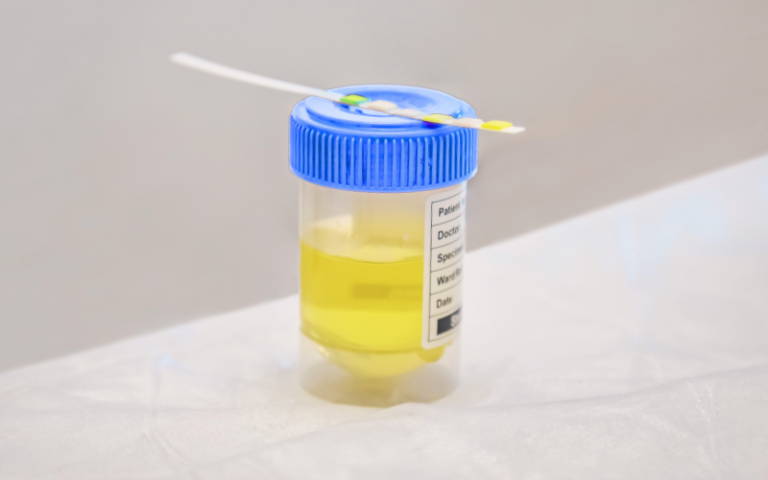
For a distributed operation, urine workplace drug testing carries the most practical constraints. Urine drug tests need appropriate facilities for sample collection, which not every remote site has. Collections can require same-gender supervision arrangements, and a donor who cannot provide a sample on demand (sometimes due to a recognised condition such as shy bladder syndrome) can delay the process. These are manageable at a single equipped site. However, as the number of sites increases, so does the complexity.
Oral Fluid Testing
Oral fluid (saliva) workplace drug tests are much more mobile. Unlike urine drug tests, they need no special facilities. This helps at remote and out-of-hours locations. Additionally, collection is observed, which supports sample integrity. Our comparison of fingerprint and oral fluid screening covers the details. Collection times and the need to manage the sample are worth weighing for a high-volume, multi-site programme.
Fingerprint Sweat Testing
Fingerprint drug tests are built around portability. A trained administrator can collect a sample in a few minutes, with no special facilities, no plumbing, and no need for gender-specific collection staff. The sample is taken from fingertip sweat, and an on-site reader provides a quick screening result. Because the equipment is portable and the process is easy to run, the same test can be carried out at a remote site, on a night shift, or during a handover by your own trained people, the same way every time. For an operation defined by distance and time, that combination of portability, speed, low disruption, and an identical process everywhere is a strong fit. You can read how fingerprint drug testing works for the mechanics.
Whichever method you choose, an on-site test gives a screening result, not a confirmed one. A result that is not negative is a non-negative screening result. It is not proof, and no action should be taken on a screening result alone. Confirmation always comes from a UKAS-accredited laboratory.
When On-Site Screening Is Not the Right Fit
The three on-site methods above are built for prompt, local decisions about possible recent use. There is one question they are not designed to answer: a longer history of use. If your priority is seeing a pattern of use over an extended period rather than whether someone may be impaired now, hair testing is the best choice. It offers a much longer detection window and is designed for exactly that deep, historical look-back. Hair testing is a laboratory-based analysis rather than an on-site one.
It is also worth being clear that no on-site method is the end of the process. Whichever screening method you choose, every non-negative result goes to a UKAS-accredited laboratory for confirmation before you act on it. Fingerprint, oral fluid, or urine, the principle is the same: on-site screening tells you quickly where to look, and the laboratory confirms the result, wherever in your operation the sample was taken.
Maintaining Consistency and Fairness Across Sites
Fairness is not only the right thing to do; it affects how people work. When staff feel like they are treated fairly, they report higher job satisfaction, stronger commitment, and better performance.
If workers at one site come to believe they are held to a stricter standard than colleagues elsewhere, trust erodes at the exact sites where you already have the least day-to-day oversight.
Additionally, consistency makes a policy legally defensible. Under UK law, an employer that acts on a drug and alcohol result may have to justify that decision, and if it leads to dismissal, an employment tribunal will examine how the process was applied. Tribunals are required to take the Acas Code of Practice on disciplinary and grievance procedures into account, and treating similar cases differently is a recognised route to a finding of unfair dismissal. A policy that is written once but applied loosely, strict at one site while informal at another, is difficult to defend.
Precision Stevedores, a ports and stevedoring operation, runs the kind of distributed, shift-based work this guide describes and shows how a consistent on-site approach can work in practice.
Bridging The Gap
For a single daytime site, the traditional callout model can work well. For an operation spread across distance and time, the picture changes. The pressures of travel cost, coordination, and out-of-hours gaps all push toward a method that travels well, runs on-site by your own trained people, returns a fast screening result, and applies identically everywhere. That is what protects consistency, and consistency is what makes a programme defensible.
If a distributed operation is your reality, the multi-site pain is also a strong reason to weigh running testing in-house. Our guide on bringing drug testing in-house covers what to consider before you switch.
For a structured way to compare the methods against the criteria that matter to your operation, download our Workplace Drug Testing Method Comparison Guide.
To see how fingerprint drug testing would work across your sites and shifts, book a demo.