Fingerprint drug testing is a versatile, non-invasive method for workplace drug screening, particularly in safety-critical industries. Employers exploring drug and alcohol testing solutions are increasingly adopting this approach due to its speed, reliability, and portability.
Despite this, several misconceptions remain. These often relate to privacy, accuracy, sample collection, and the interpretation of results. Many of these concerns stem from unfamiliarity with the underlying science and how the system operates in practice.
Understanding the strengths and limitations of fingerprint drug testing helps organisations make informed decisions about their drug and alcohol policies.
Below are five common myths about fingerprint drug testing, along with what the science and practical experience show.
“It Scans and Stores My Biometric Fingerprint Data.”
Myth. Fingerprint drug testing does not capture or store fingerprint images or biometric data.
The Intelligent Fingerprinting Drug Screening System analyses trace amounts of sweat from the fingertips. It does not record ridge patterns or any identifying features. The process uses lateral flow immunoassay technology, where a buffer solution dissolves any trace of the fingerprint during collection.
Sample collectors follow data protection protocols aligned with General Data Protection Regulation (GDPR) to safeguard donor privacy. Where laboratory confirmation is required, anonymised barcodes are used instead of personal identifiers.
This approach ensures the test cannot be used for identification and maintains strict privacy standards expected across drug testing companies in the UK.
“I Touched Banknotes or a Public Surface. That Is Why My Result Is Non-Negative.”
Myth. Environmental contact alone does not produce a non-negative result.
Research conducted in collaboration with the University of Surrey shows that background contamination from surfaces such as banknotes or door handles has minimal impact on results. The system is designed to detect drugs and their metabolites, which are only produced after the body processes a substance.
Surface contact does not create metabolites.
In addition, the test uses clinically established cut-offs derived from controlled dosing studies. These thresholds are carefully set to distinguish between true drug use and trace environmental exposure. This balance ensures that incidental contact falls below the detection threshold, while biologically relevant drug use is identified.
“I Do Not Sweat, So I Cannot Provide a Sample.”
Myth. Everyone naturally produces eccrine sweat, even when it is not visible. Eccrine sweat glands are continuously active and secrete very small amounts of perspiration as part of normal thermoregulation and skin hydration.
Fingerprint drug testing does not rely on visible sweating; it detects trace amounts of naturally present sweat on the fingertips. A sufficient sample volume can be obtained from almost all individuals under normal environmental conditions.
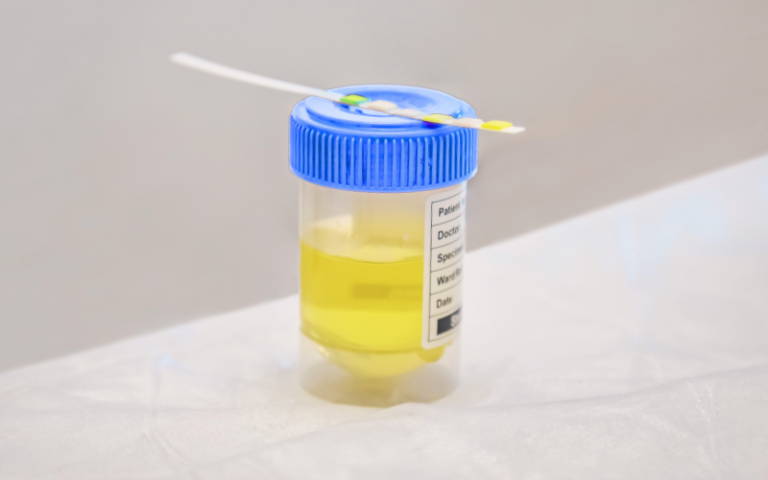
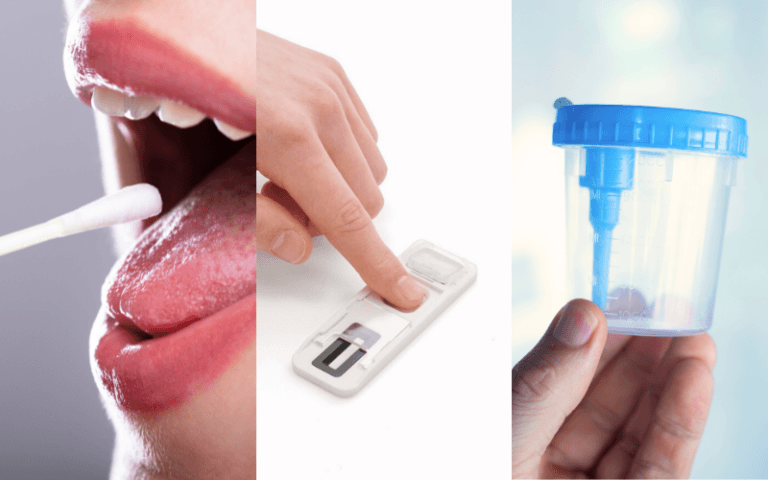
This makes it a practical alternative to traditional methods such as a saliva drug test or urine drug test, which rely on active sample production.
“The Smaller Sample Means the Test Is Less Accurate.”
Myth. While fingerprint sweat drug testing uses a much smaller sample volume than urine or saliva, modern analytical techniques are specifically designed to detect drugs at extremely low concentrations. Sweat samples are measured in picograms, but the immunoassay technology used in the screening device is highly sensitive, and laboratory confirmation by liquid chromatography–mass spectrometry can achieve precise detection at these levels.
Accuracy is not determined solely by sample size, but also by assay sensitivity, specificity, and clinically validated cut-offs. During development, controlled dosing studies have been used to establish appropriate thresholds that reliably distinguish true positives from true negatives.
This ensures fingerprint testing performs reliably alongside other workplace drug testing products.
“Fingerprint Drug Testing Can Be Easily Fooled or Manipulated.”
Myth. Fingerprint drug tests are designed to reduce opportunities for tampering.
Sample collection is fully observable and completed in seconds, with the donor placing their fingertips onto a cartridge. This removes the need for private facilities and reduces the opportunity for substitution or interference.
Unlike urine or saliva testing, there are no requirements for controlled environments, waiting periods, or additional preparation steps that can introduce variability.
The combination of observed collection, tamper-evident components, and automated analysis delivers consistent, reliable results.
Traditional vs Modern Workplace Drug Testing
Traditional drug testing methods, such as urine and saliva testing, often introduce operational challenges. While both these methods can deliver accurate results, many myths still surround all the details. To learn more, read our blogs, Top 5 Myths About Oral Fluid Drug Tests and Top 5 Myths About Urine Drug Tests.
These challenges can include delays, the need for dedicated facilities, and processes that some employees may find invasive, particularly during a pre-employment drug test or random screening.
Fingerprint drug testing addresses many of these limitations.
The method is non-invasive and involves a simple, hygienic collection process using the fingertips. Sample collection takes only seconds and can be performed quickly across multiple individuals without disrupting operations.
Because the process is fully observable and requires no facility setup, it reduces delays and improves efficiency. There is no need for toilets, supervised collection areas, or waiting periods. For organisations operating in safety-critical environments, this enables faster, more relevant decision-making while maintaining a fair and proportionate approach to drug testing.
To learn more, download our white paper, The Science Behind Fingerprint Drug Testing, and gain a clear understanding of the principles, performance, and practical application of this approach.
See How Fingerprint Drug Testing Works
Choosing the right testing method depends on your organisation’s operational requirements, workforce considerations, and policy objectives.
To see fingerprint drug testing in action, schedule a demo with Intelligent Fingerprinting. Learn how this approach improves efficiency, supports privacy, and provides reliable insight into recent drug use.