Recent advancements in drug screening technology have been propelled by a groundbreaking study from King’s College London. The research, led by Caroline Pollard and Kim Wolff at Kings College London (KCL), explores usage of the Ridgeway tool from Intelligent Fingerprinting to measure sweat deposition in latent fingerprints (LFPs). This study, published in Forensic Science International, sheds light on a novel application of refractive index (RI) technology, paving the way for more accurate and non-invasive drug testing methods.
Summary of Research
The Ridgeway tool, developed by Paul Wilson, Head of Special Projects at Intelligent Fingerprinting, and Benjamin Gordon of Gordon Design Consultants, utilises a unique method to measure the refractive index of LFPs, allowing for precise quantification of sweat deposited at the time of fingerprint collection. The study found a strong correlation (r = 0.868) between the Ridgeway score (Rs) and the actual mass of the sweat, demonstrating the tool’s effectiveness. By controlling variables like deposition pressure and surface, the researchers were able to consistently collect comparable fingerprint samples, showing no significant difference between the left and right index fingers.
What It Means in Common Terms
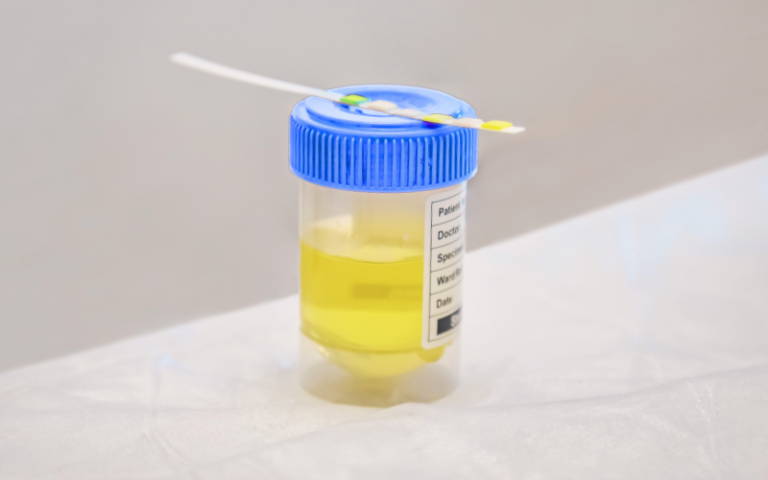
The Ridgeway tool works like a high-tech set of scales that can “see” how much sweat is present in a fingerprint on a glass surface. This is important because sweat contains small amounts of substances, including drugs, that a person might have ingested. By accurately measuring the amount of sweat, the Ridgeway uniquely enables more precise reporting of drugs present because the size of the fingerprint sample i.e. the size of the person’s fingertips can be considered. Fingerprint drug testing is much simpler and less invasive than traditional drug tests like blood or urine tests. It only requires a person to press their finger on a special slide, and the tool does the rest.
The study also showed that the Ridgeway could distinguish between different types of sweat left behind in fingerprints. For instance, it could tell if the sweat was from natural bodily processes or if it had been contaminated by touching things like hair or food. This differentiation is crucial for ensuring the accuracy of drug tests, as it helps avoid false positives caused by external contamination.
Implications and Benefits
This ability to measure sweat deposition accurately offers numerous benefits for drug screening. Traditional methods often require more invasive procedures, but this allows for quick and non-invasive testing. It’s particularly useful in situations where privacy and hygiene are priorities, such as in workplaces or law enforcement settings. Moreover, the tool’s precision in differentiating between sweat types means it can reliably indicate whether drugs were ingested, as opposed to merely coming into contact with a contaminated surface.
The findings from this study highlight the potential of the Intelligent Fingerprinting method in transforming drug screening processes and cutting-edge science being developed to support the technology. Intelligent Fingerprinting’s platform offers a promising alternative to traditional methods, providing accurate, quick, and dignified testing. As this technology continues to develop, it is setting new standards for fingerprint analysis in forensic science and beyond, making drug testing more accessible and less intrusive.