Originally published by the HR Director.
New Drug Testing to Combat Drug Misuse in the Workplace
Contrary to popular stereotypes which portray drug users as homeless, unemployed or on the edge of society, almost one in ten of the UK workforce admits to recent drug misuse, according to a report commissioned by the Department of Health in 2012. With a comment from Dr Paul Yates, from Intelligent Fingerprinting.
While occupation type has a bearing on illicit drug use statistics, a study by the UK Health & Safety Executive noted that many working drug users are well-educated, reside in more affluent urban areas and are in managerial or professional roles. It is difficult to measure the financial and social impact of drug addiction on UK businesses, but illicit drug use by employees is linked to increased absenteeism, reduced productivity, a higher risk of accidents and theft to finance addiction. So, what should employers be doing to protect their business from the impact of drug misuse, and how can they identify employees who need help?
Dr Paul Yates, from Intelligent Fingerprinting, explains the importance of establishing an effective workplace drug policy and describes how a new fingerprint-screening device could deter and reduce drug use at work with just a touch of a finger. Employers have a general duty under the Health & Safety at Work Act 1974 to ensure the health, safety and welfare at work of their employees. The most important starting point for businesses when addressing the issue of substance misuse is to establish effective workplace alcohol and drug policies, which set out rules regarding the use of illicit drugs and alcohol, outline the support available to employees who have a problem, and explain the sanctions associated with employees who abuse the policy.
Unlike alcohol problems, drug abuse can be difficult to detect in employees, and managers may need coaching to spot the subtle signs of drug use. Drug screening is an effective tool for employers to help identify individuals who require support and also to deter drug misuse in the first place. The use of drug screening varies between industry sectors. It is most frequently used in safety-critical areas such as transport and energy generation, or after an incident. There is also increased usage in the construction industry. Companies’ drug screening policies differ, but they often encompass pre-employment, fitness-for-duty, post-accident, and random testing.
While many companies have introduced drug screening to ensure the safety and well-being of their employees and the public, existing drug screening methods have limitations and drawbacks. Tests currently on the market require the collection of body fluid samples such as blood, urine, or oral fluid (saliva), which are either analysed immediately using a disposable kit or sent for laboratory analysis. There are several problems with body fluid screening kits that affect the overall effectiveness of policies and the costs of implementing them. The main problem is the need to collect invasive samples. Body fluid sample collection processes are generally considered unpleasant, undignified, and expensive to administer. Samples are a biohazard and require collection by specialist staff, often in pre-prepared sample collection areas, and costly waste disposal.
Before, during and immediately after sample collection, there are opportunities to contaminate, adulterate or dilute samples, all of which render the tests unusable or unreliable. (A cursory search of the internet will reveal a whole industry dedicated to helping drug users ‘beat’ conventional drug screening tests.) In addition, sample misidentification by the collector can lead to false positives, causing stress to employees and expensive tribunal payouts for employers.
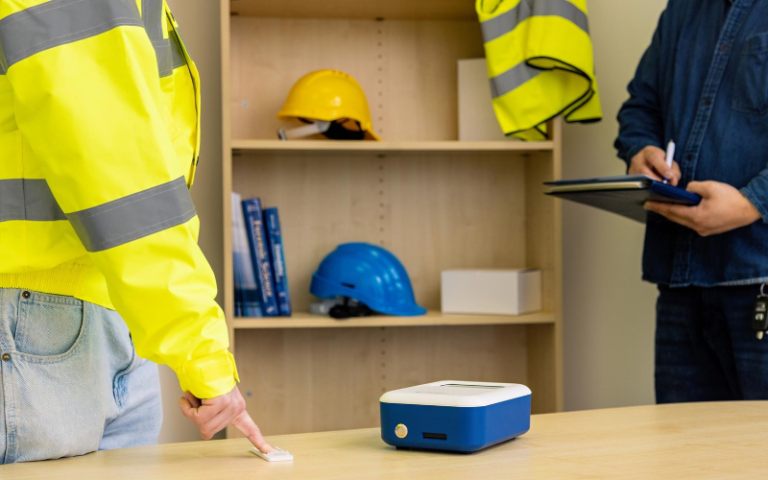
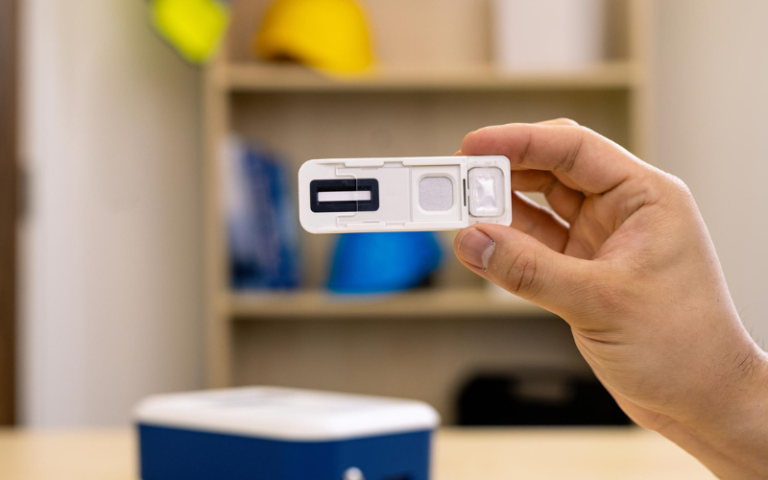
Now, a new invention by the British medical device company Intelligent Fingerprinting could revolutionise the way drug screening is carried out across many areas of society, including the workplace. The company is developing the world’s first mobile fingerprint-based drug-screening device. With this new method, a screening sample is collected by simply touching the donor’s fingerprint to a small collection Cartridge. The Cartridge is inserted into the company’s handheld test reader, which analyses the donor’s fingerprint sweat to screen for up to five drug groups simultaneously, with results in less than ten minutes.
In contrast to conventional body fluid drug screening methods, Intelligent Fingerprinting’s technology is wholly non-invasive and non-biohazardous, offering significant ease-of-use and cost-saving benefits over existing techniques. With fingerprint-based screening, there is no need for specially prepared sample collection areas. Screening can be implemented quickly and safely at any location by non-specialist staff to support random screening programmes and maximise the deterrent effect of an employer’s drug policy. The device also enables post-accident tests to be carried out immediately without waiting for the arrival of costly collection staff, which is often a problem when accidents occur outside normal office hours or at remote locations. And because the sample Cartridges are non-biohazardous, there is no need for expensive waste disposal services.
It is expected that future versions of the fingerprint Reader will include a biometric option that would enable an employer to cross-check an individual’s identity against the company’s HR database as part of fitness-for-duty screening, to provide accurate management information, and to protect employees against sample misidentification and false positives. With commercial production due to begin in 2015, the introduction of this fingerprint-based drug screen could undoubtedly improve the convenience, effectiveness and value for money of any workplace drug screening policy. Visit the Intelligent Fingerprinting website for further information about fingerprint drug screening.