Is workplace drug testing worth it?
A fair question. Most organisations weigh the cost of testing against zero: the price of the kits versus doing nothing at all. Counted that way, testing will always look like an expense to contain.
But that sum measures only one side of the ledger. It ignores what a well-run programme earns and protects. Once you count both sides, the question changes from “how much does it cost?” to “what is the return?”
This article sets out the four returns a workplace drug and alcohol testing programme delivers.
First, Why This Is Not a Fringe Issue
Drug use is not confined to a small group at the margins of the workforce. According to the Crime Survey for England and Wales, around 8.7 per cent of people aged 16 to 59, roughly 2.9 million people, reported using drugs in the last year. That is a typical cross-section of the working-age population, and therefore of an average workforce. The point is not that these people are unfit to work; a credible programme should be built for the real world, not an idealised one.
So the question is whether managing the risk is worth the cost. Here are the four returns that answer it.
Return One: Winning Work
For many employers, the clearest return arrives in the procurement inbox. In construction, transport, logistics, and other safety-critical sectors, organisations awarding contracts increasingly treat a documented drug and alcohol policy and a demonstrable ability to test as baseline requirements. A testing programme can mean the difference between being invited to tender and being passed over before you say a word.
“From a commercial point, a lot of the big contracts we are looking for or being asked to bid for are now requesting the capacity to be able to test.”
Tony Jackson is Head of Safety, Health, Environment and Quality at Sinewave
Return Two: Keeping the People You Have Invested In
Recruiting is expensive, and replacing a skilled worker is slow. A new hire can take months to reach full productivity, and that cost bites hardest where skilled labour is scarce, which, right now, is almost everywhere. The Recruitment and Employment Confederation estimates that labour and skills shortages could cost the UK economy as much as £39 billion a year. Losing a trained, experienced employee in that climate is not a minor inconvenience; it is the loss of an asset that takes real time and money to rebuild. A programme built around dignity rather than suspicion protects that investment instead of putting good people through an ordeal.
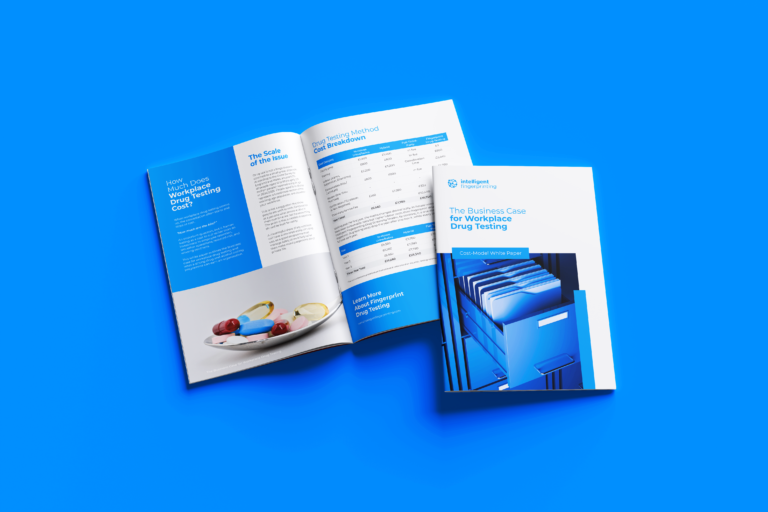
Download The Business Case for Workplace Drug Testing here.Finding this useful? The full case, with the numbers behind every return, is in our white paper. |
Return Three: Getting Working Time Back
The cost most organisations miss is the one that never appears on an invoice: time. Every minute staff spend being tested is a minute away from their work. With methods like urine testing, that time adds up fast, between facilities preparing, collections being supervised, and donors and administrators left waiting. The kit is rarely the expensive part. The hidden cost is operational time, and the right method hands those hours back to the workforce.
For a full cost breakdown across common testing methods, our white paper does the maths, or you can run your own numbers with the drug testing cost calculator.
Return Four: A Programme You Can Stand Behind
The final return is protection. When something goes wrong, regulators and tribunals judge employers on evidence, not good intentions, and the exposure is real: fines are based on turnover and can run into the millions, before you count legal costs, higher insurance premiums, and the work lost while you are under scrutiny. By comparison, the cost of running a programme is small.
“The cost of implementing a drug and alcohol policy and testing is negligible compared to the cost of not doing it… Fines are well capable of shutting a business down.”
Charlotte Le Maire, Founder and Partner at LMP Legal
A consistent, auditable, defensible programme is cheap insurance against an otherwise uncapped bill.
Is Workplace Drug Testing Worth It?
The real comparison should not be “testing versus nothing.” Compare the cost of a programme against the work you win, the people you keep, the time you recover, and the risk you cap. Those four returns turn drug testing at work from a line-item cost into an investment that pays for itself.
A fifth thread runs through all four: the people themselves. A programme that treats staff with dignity not only protects the business; it protects the trust that keeps good people in post.
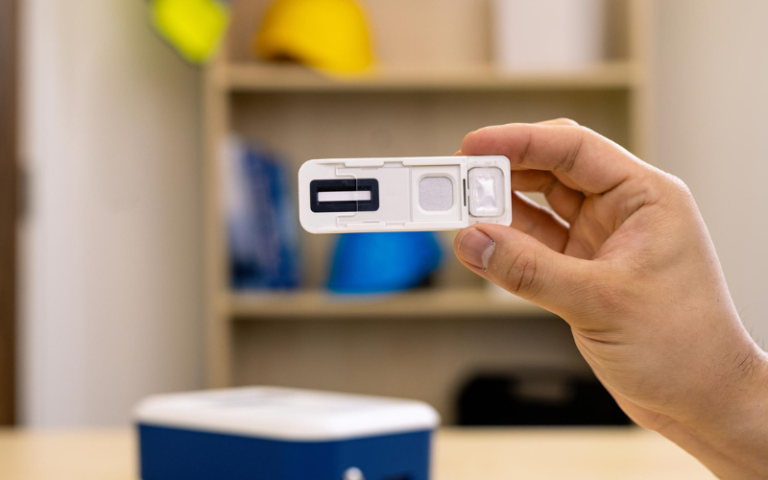
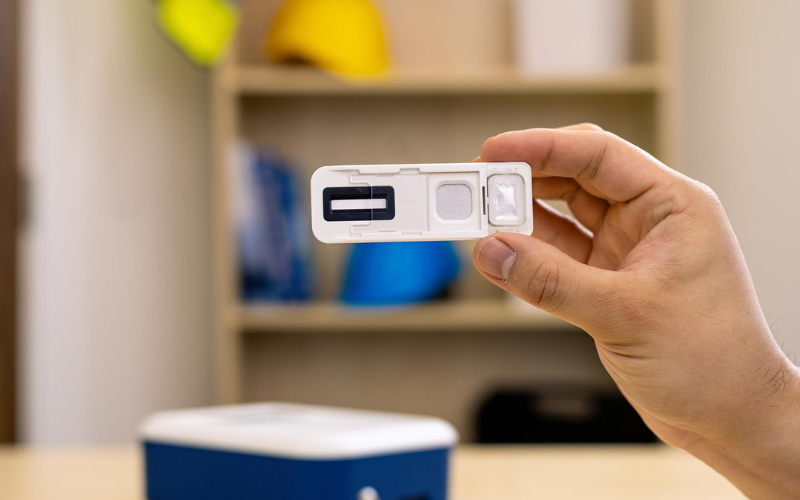
This is where fingerprint drug testing earns its place. It was designed to address all the concerns at once: a non-invasive screen that needs no special facilities keeps disruption and running costs down, supports a documented, defensible programme that wins work and caps risk, and produces an automatic audit trail as a by-product of testing. Because the sample is collected with dignity rather than through supervised urine collection, it protects the trust that keeps good people in post. In short, it answers the commercial and human cases in the same process.
See the full business case. Our white paper backs up all four returns with numbers, including a method-by-method cost comparison across three years. Download The Business Case for Workplace Drug Testing.
Prefer to see it in practice? Contact us for a demo and we will show you how fingerprint drug testing supports a programme that earns its keep.
Cost is based on the total cost of workplace testing programs and return on investment, including equipment, labour, and facility requirements, rather than cost per test unit alone. Actual costs may vary depending on testing volume and workplace procedures.